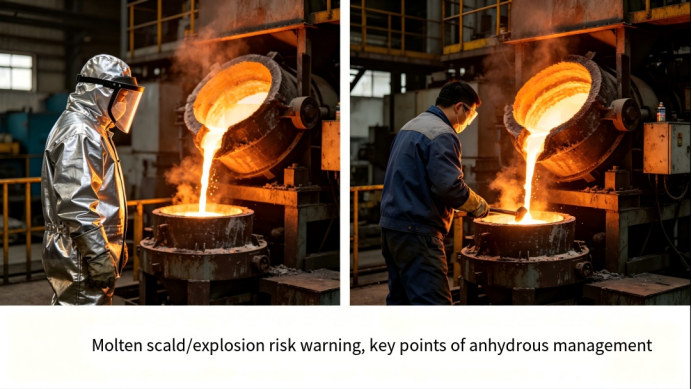
In the metal melting industry, the safety risks in the melting processing area are particularly prominent. Scalding from molten metal is the most frequent accident on a daily basis, while the explosion of molten metal caused by contact with water is the most serious extreme risk. These two types of accidents are of the utmost importance in the safety control of metal melting enterprises, leaving no room for slackness!
1. Scalding from molten metal
The temperature of the molten metal can be as high as 700-1600 ° C, far beyond the human body’s tolerance limit. Even slight contact can cause deep burns, which is the most common type of injury in metal melting workshops.
1. High incidence scenarios
Splashing or dripping of molten liquid during liquid discharge, slag removal, temperature measurement, and furnace mouth cleaning; Inadequate preheating of the sprue, ladle, or tool, with contact with molten spatter; The furnace body and the flow trough leak, and the inspectors cannot dodge in time; When lifting the molten ladle, shaking and bumping caused the molten to spill.
2 Core causes (mostly “habitual violations”)
Failure to wear heat-resistant flame-retardant clothing, protective face shields, and long heat-insulating gloves as required; Improper operation position, facing the direction of molten flow or splash; Tools (slag scoops, temperature-measuring rods) are wet, wet or not preheated; The equipment is aged, the furnace lining is damaged, and the launder is poorly sealed.
3. Typical accident cases
Zhang, an operator in a metal melting enterprise, did not wear the protective face shield as required during the liquid discharge operation. He only wore ordinary gloves and stood directly facing the liquid discharge outlet. Due to insufficient preheating of the launder, the molten liquid was slightly splashed upon contact with the launder, and the high-temperature molten liquid directly splashed onto Zhang’s face and hands, causing deep burns on his face and extensive ulceration of the skin on his hands. After three months of hospitalization, permanent scars were still left. The enterprise was also ordered to suspend production for rectification due to the violation of operation and bear huge medical and rectification costs.
Warning: Habitual violations may seem minor, but they can cause lifelong harm. Both personal protection and proper operation are indispensable.
2. Explosion of molten liquid
When molten metal meets water/wet material, it explodes violently in an instant, with power comparable to that of explosives. The molten debris scatters with shock waves and can instantly destroy equipment and cause mass casualties. It is the most terrifying safety accident in the metal melting industry.
1. The principle of the explosion
When the molten liquid at 700 ° C + comes into contact with water, the water instantly vaporizes and expands 1700 times. At the same time, some of the metal undergoes a chemical reaction with the water to produce hydrogen gas. Under the double effect, a violent explosion occurs, and the molten liquid splinters at high speed, covering an area of tens of meters.
2 Typical trigger scenarios
Residual water remains inside the furnace body, launder and ladle, and they come into contact with the molten liquid before being dried. When working in the rain, rainwater drifts into the furnace mouth, runner or ladle; The cooling water pipe leaks and the water flows directly into the hot melt; Wet slag and waste are directly thrown into the high-temperature melting furnace; The water on the ground was not cleared, and the molten leakage came into contact with the water.
3. Accident consequences
① Personnel: Deep burns, shock wave impacts, molten debris punctures, extremely high mortality rate;
② Equipment: Melting furnaces, flow troughs, ladles burst directly, workshop facilities are damaged;
③ Environment: The high-temperature molten material ignites the combustible material, causing secondary fires.
4. Typical accident cases
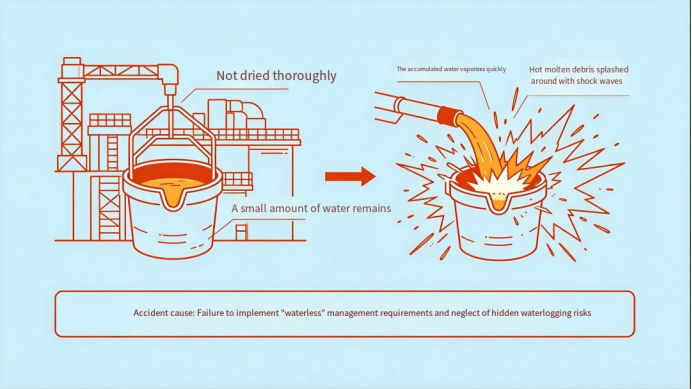
In a large metal melting plant, the ladle was not thoroughly dried before the melting operation, leaving a small amount of water inside the ladle. When the hot molten liquid was injected into the ladle, the water vaporized rapidly and caused a violent explosion. The ladle was blown open, and the hot molten liquid debris splashed around with shock waves, causing six operators to die on the spot, 12 people to be burned to varying degrees, the melting workshop was severely damaged, all the surrounding equipment was scrapped, and the direct economic loss exceeded 10 million yuan. The person in charge of the enterprise and the relevant responsible persons were held criminally liable. The cause of the accident was the failure to implement the “waterless” management requirements and the neglect of the hidden risk of water accumulation, which eventually led to the tragedy.
3. Core safety control in the metal melting industry
1. Prevent scalding from molten metal
① Personal protection: All personnel must wear high-temperature resistant and flame-retardant work clothes, anti-smashing and heat-insulating safety shoes, protective face shields, long high-temperature resistant gloves. It is strictly forbidden to enter the work area wearing short sleeves, shorts, and synthetic fiber clothing.
② Work operations: All tools that come into contact with the molten liquid (ladles, temperature measuring rods, ladles) must be fully preheated and dried to ensure there is no moisture before use; When pouring out, slagging and casting, the operator should stand in a safe side position and must not face the flow of the molten liquid directly. It is strictly forbidden to cross the launder or molten tank, and the inspection route should avoid the range of molten spatter.
③ Equipment inspection: Check the lining of the furnace, the launder, and the ladle for damage and leakage every shift. If cracks or corrosion are found, stop the operation immediately for maintenance to prevent “operating while faulty”.
2 Guard against molten explosion
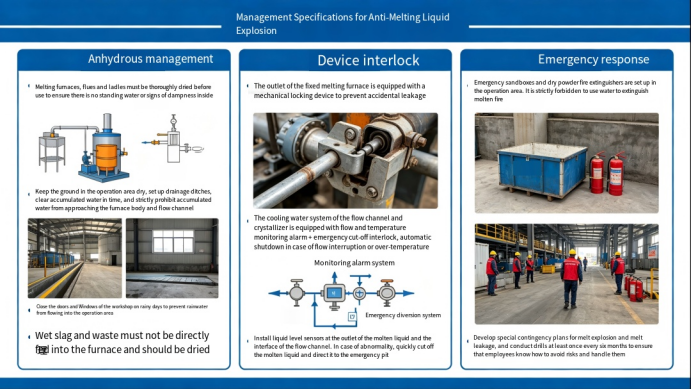
① “No water” management: Melting furnaces, ladles, and pouring ladles must be thoroughly dried before use, with no water accumulation or moisture marks inside; The ground in the operation area should be kept dry, drainage ditches should be set up, water should be cleared in a timely manner, and it is strictly forbidden for water to come near the furnace body and the launder; Close the workshop doors and Windows on rainy days to prevent rainwater from flowing into the operation area; Damp slag and waste are strictly prohibited from being directly put into the furnace and must be dried.
② Equipment interlock: Mechanical locking devices are installed at the liquid outlet of the fixed melting furnace to prevent accidental leakage; Flow and temperature monitoring alarm + emergency shut-off interlock is provided for the cooling water system of the launder and crystallizer, and the furnace is automatically shut down in case of flow interruption or over-temperature. Liquid level sensors are installed at the outlet of the molten liquid and the interface of the launder. In case of abnormality, the molten liquid is quickly cut off and directed to the emergency pit.
③ Emergency response: Emergency sandboxes and dry powder fire extinguishers are set up in the operation area. It is strictly forbidden to use water to extinguish molten fire. Develop special contingency plans for melt explosion and melt leakage, and conduct drills at least once every six months to ensure that employees know how to avoid risks and handle them.
3. Safety of all personnel
① New employees must receive specialized training on the risk of molten scalding and molten explosion before taking up their posts and pass the assessment.
② Regularly conduct warning education on accident cases, organize employees to study typical cases, deeply analyze the causes of accidents, and make employees deeply realize that “violation is fatal”;
③ Strictly investigate the “three violations” (violation of command, violation of operation, violation of labor discipline), and deal with behaviors such as wet tools, improper positioning, and inadequate protection with zero tolerance.
4. Conclusion
In the metal melting industry, molten scald is the “daily alarm”, and molten explosion is the “ultimate red line”. The two typical cases mentioned above are the painful price of operating in violation of regulations and ignoring risks. The lessons are profound and the alarm bells are always ringing.
Safety is no small matter; details determine life and death. Only by implementing every measure of “preventing scalding and molten explosion” and controlling every risk point can we ensure the safety of employees’ lives and the stable development of the enterprise!